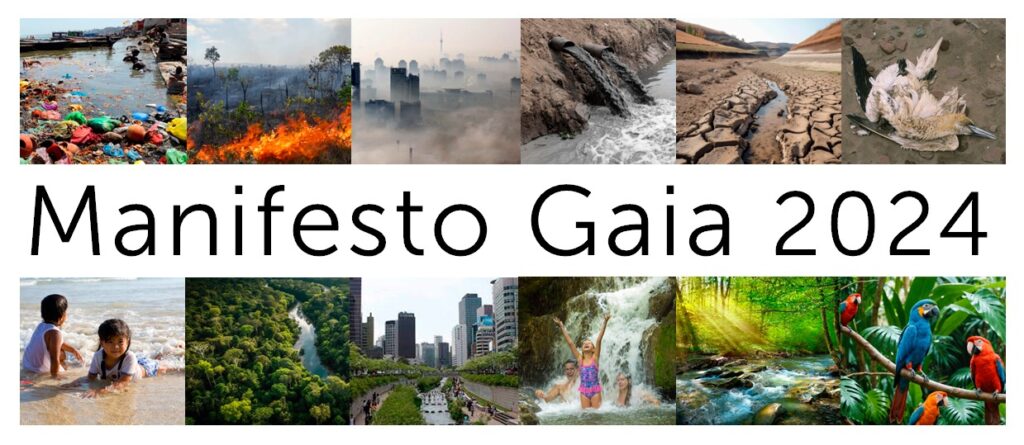
Manifesto Gaia – 2024
– Warning, Appeal, Commitment –
On July 9, 1955, during a press conference held in London, the Russell-Einstein Manifesto was presented to the world. It was drafted by Russell and endorsed by Einstein and nine other renowned scientists and intellectuals. The Manifesto aimed to alert the world to the dire consequences of nuclear war and proposed the peaceful resolution of international conflicts to avoid “universal death.”
Based on the principles and concepts of various current thinkers and adopting several terms and phrases (italicized in the following text) from the 1955 document, the signatories of this Manifesto appeal to all their brothers, inhabitants of our Common Home, to become aware of the dire consequences – which could lead to a “universal death” – of environmental changes, including climate change, that we are causing across the Planet.
If you agree with the terms of this Manifesto, subscribe to it as a sign of your decision to adopt a new way of life that drastically reduces environmental impacts and simultaneously promotes true prosperity and happiness.
Warning, originating from Reason: from science and observation
The increasing imbalance that human actions have caused in Gaia, a unified system of entities and complex relationships of close interdependence that includes living beings – human or not – and the world in which they live, has resulted in damage that seriously endangers survival of humanity itself. If life as we know it is to continue, we urgently need a new way of thinking and a new way of living.
Indeed, in the tragic situation which confronts humanity, with rapid and escalating climate and ecosystem degradation, we feel that all of us must rethink our lives and seriously assess the dangers that have arisen as a result of a development based on rampant consumerism by a segment of the population at the expense of the majority of inhabitants, fauna, and flora of the Earth. This development is based on the illusion that infinite growth is possible on a finite Planet, on the myth that prosperity is only possible with growth, and on the presumption that we can abuse nature with impunity.
We are speaking on this occasion, not as members of this or that nation, continent, or creed, but as human beings, members of the species Homo Sapiens, whose existence in the coming decades and centuries is in doubt.
In addition to environmental degradation, the world is full of conflicts between individuals, social groups, ideologies, beliefs, countries, global strategic blocs, productive sectors, transnational and multinational companies, and members of government institutions. Furthermore, conflicts will surely worsen due to disputes over resources and strategic spaces resulting from the consistent intensification of environmental problems.
The intensification of rivalries could result in wars and the nuclear holocaust, long feared and never dispelled by global renunciation of nuclear weapons and by a decision of all the world’s governments to find peaceful means to resolve all disputes among them.
We inherited from our ancestors a habitable, beautiful, relatively stable, balanced Planet, with immense resources that have allowed us to reach where we are today.
However, greed, selfishness, and the lack of vision of those who have taken positions of authority and those who have appropriated most of the economic goods have already put all of us at serious risk, with a significant threat to the survival of many in the present and future generations. There is no denying that a vast portion of the world’s population remains on the margins of the touted benefits that technology, science, and policies of so-called economic development have brought to a minority, increasingly selfish and wealth-concentrating, of the contemporary civilization. Simply check the data regarding hunger, misery, and poverty among vast populations, the lack of basic sanitation and potable water, the situation in refugee camps, and the massive migrations of those seeking to escape inhuman conditions of life under local tyrannies or wars.
In a situation where rationality undoubtedly prescribes cooperation, sobriety, unity, solidarity, compassion, and non-violent action, humanity has preferred the historically trodden path of attacking groups and countries that each segment elects as its enemy, the culprit for the misfortune it suffers.
The general population, and even most people in positions of authority, have not yet realized, with the necessary depth and clarity, what is involved in the Planet’s environmental situation. The general public has been led, albeit incipiently, to think only about climate change, whose effects on temperature, rainfall, and droughts are easier to perceive.
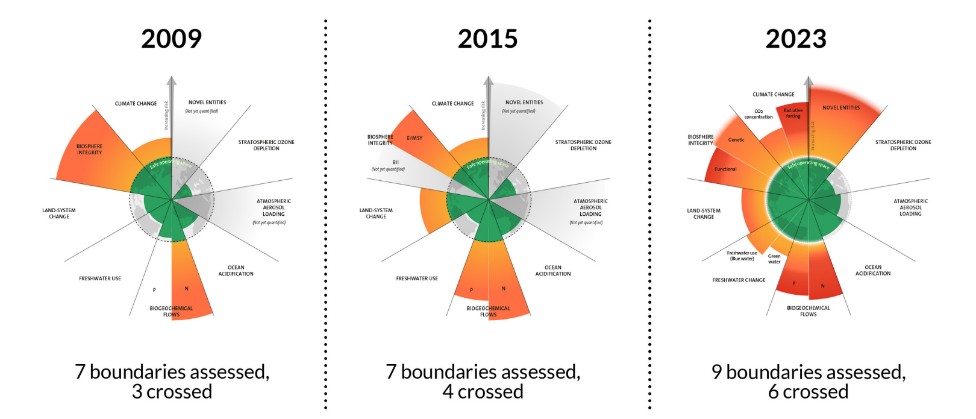
However, by 2023, we have already exceeded the safe limits for the continuation of life on Earth in at least five areas: biosphere integrity, novel entities, changes in land use and freshwater consumption, and biogeochemical flows. And, as it seems, three other limits will soon also be surpassed: ocean acidification, atmospheric aerosol loading, and ozone layer destruction.
Climate change – concentration of CO2 and other greenhouse gases, energy balance between Earth and space.
Novel entities – Pollution caused by new chemical compounds such as plastics, paints, pesticides, cosmetics, etc.
Stratospheric ozone depletion – Holes in the ozone layer caused by chlorine-containing gases like CFCs.
Atmospheric aerosol loading – Atmospheric pollutants such as dust and smoke.
Ocean acidification – Concentration of carbonate ions in the ocean.
Biogeochemical flows – Water pollution by nitrogen and phosphorus from agricultural fertilizers – Eutrophication.
Changes in freshwater availability – Amount of water available for humans and plants. Green: water contained in plants, soil, and clouds. Blue: water from rivers, lakes, glaciers, and aquifers.
Land-system use – Size of forested areas and other biomes.
Biosphere integrity – Loss of biodiversity and the speed of species extinction.
Many warnings have been uttered by eminent men of science and by authorities in politics, economics, and sociology. None of them will say that the worst and most degraded environmental and climatic conditions are certain. What they say is that these conditions are getting closer every day, and no one can be sure that they will not be reached in the coming years and decades if the precepts and directions of the current economy and technology are not immediately and drastically altered. We have not yet found that the views of experts on this question depend in any degree upon their politics or prejudices. They depend only, so far as our researches have revealed, upon the extent of the particular expert’s knowledge and intellectual honesty.
But what perhaps impedes understanding of the situation more than anything else is that the term “mankind” feels vague and abstract.
People scarcely realize in imagination that the danger is to themselves and their children and their grandchildren, and not only to a dimly apprehended humanity. They can scarcely bring themselves to grasp that they, individually, and those whom they love are in imminent danger of perishing agonizingly. And so they hope that current courses can continue, as long as some minor adjustments are made, as long as new technologies are developed. But most of the technology we have created since the Industrial Revolution has solved problems only at the cost of creating new and more complex problems, in an ever-increasing spiral. It has been proven, just like the economy, to be a technology that kills.
This hope that minor adjustments and advanced technologies will prevent serious degradation of the environment and climate is illusory. Most limits have already been exceeded, and returning to previous conditions will take hundreds, probably thousands of years, if the necessary changes are made extensively and rapidly.
Here, then, is the problem which we present, stark and dreadful and inescapable: Shall we put an end to the human species; or shall mankind renounce the current economic and technological model? Those who are advantaged today will hardly accept a change in course, as they prefer to maintain their privileges, which they consider to be acquired rights, even in the face of undeniable prospects of general annihilation.
Appeal, coming from the Heart: from common sense, responsibility, solidarity
Almost everybody who is politically conscious has strong feelings about one or more of these issues; but we want everyone, if can, to set aside such feelings and consider themselves only as members of a biological species which has had a remarkable history, and whose disappearance none of us can desire.
We shall try to say no single word which should appeal to one group rather than to another. We all, equally, are in peril, and, if the peril is understood, there is hope that we may collectively avert it.
We have to learn to think in a new way. We have to learn to ask ourselves, not what steps can be taken to allow, even with adjustments, the continuation of the economic and technological model and the social organization that brought us to the situation we are in, for there no longer are such steps; the question we have to ask ourselves is: what steps can be taken to define a new model that allows humanity to live in harmony with itself and with all living beings on the Planet? What steps can be taken to mitigate the consequences of the environmental damage we have already caused and to prevent its escalation in the short, medium, and long term, since the maintenance of our current course is proving to be disastrous to all humanity?
The profound alteration of the economic and technological model will require – especially from those who have the most – great sacrifices and renunciations, great strength, persistence, and resignation. It will require unprecedented negotiations and agreements considered to be almost impossible between nations.
To grasp the enormity of our recklessness and irresponsibility, we only need to imagine how we would feel if our ancestors had left us the world in the current condition we are leaving it to today’s youth and future generations. We cannot continue to squander the inheritance we received and deny our descendants the legitimate right they have to inhabit the Earth as it was until recently. Although they may not be able to punish many of us who have already died, they will certainly condemn us with even greater rigor and reason if we do not decisively strive, from now on, to repair the harm we have already caused.
For this reason, it is our obligation to minimize – and, if possible, eliminate – the emission of harmful elements such as greenhouse gases, chemicals, and new entities and urgently and comprehensively restore all areas of Earth that human action has degraded.
It is also mandatory for us to keep intact, without exceptions, the areas that still remain with good natural conditions, preventing any anthropic action in them, such as urbanization, agriculture, mining, fishing, logging, and others. The restoration of degraded areas and the maintenance of still preserved areas will, as we know, become increasingly difficult in a reality with extreme events of droughts and rains, wildfires, strong winds, and dust storms.
There lies before us, if we choose, the possibility of a future world where all human beings can live in cooperation, happiness, with knowledge, and wisdom, in harmony with the surviving animals and plants that we have subjected to terrible conditions and conditions that will be even worse. Shall we, instead, choose death, because we cannot forget our quarrels, our selfishness, our personal comfort?
We cannot wait for others – especially leaders, politicians, and businessmen – to take the lead in the transformation process, as they are generally responsible for maintaining the course of destruction to ensure the privileges of those who benefit from it. They should have long ago initiated ambitious and decisive actions to end our dependence on fossil fuels, stop the destruction of life support systems on Earth, and promote environmental and climate justice for all. They have not done so or have done it insufficiently.
Therefore, it is necessary to hold rulers, legislators, and businessmen accountable, based on the concepts of precaution and prevention, for violations of human and environmental rights resulting from their omission or improper action. This may require a new legal framework, which will depend on lawmakers whose competence, commitment, and honesty have been questionable.
Science could not be clearer. The cost of inaction will be measured in destroyed cities, lost lives, collapsed economies, and extinct species, but there is still much that can and must be done to avoid the worst.
The greatest task we have now, perhaps the greatest in all history, is to deeply understand that each of us, to a greater or lesser extent, is an atom of the immense bomb that is devastating the Earth, day and night, and for over a century, with destructive power that has been exponentially growing over time.
And once aware, we need to make the difficult personal decision – even more difficult to maintain – to take the lead in changes where we live, converting to a new way of life that causes the least possible impact on the nature upon which we all depend.
Only a sincere inner transformation of each of us can make others, following our example, also transform. And, thus, everyone, united, could firmly involve, in the new way of life, the portion of humanity that has refused to chance the harmful way of living.
We appeal as human beings to human beings: let us remember our humanity and forget the rest. If we can do so, the way lies open to a new Paradise; if we cannot, there lies before us the risk of universal death.
Commitment, coming from the Will: from leadership, attitudes, and the decision to redirect history, processes, behaviors
Therefore, we, the signatories of this Manifesto, having sought to inform ourselves in the best possible manner and deliberated deeply on the current situation, invite all people of goodwill from all corners of the Earth to reflect deeply on the themes, concepts, and principles outlined here and then, if in agreement with the terms of this Manifesto, to add their signature as a sign of commitment – with a special emphasis from those who possess the most and are responsible for the greatest share of consumption – to a continuous conversion process aimed at:
• Being rather than having, relating rather than dominating: opting for a simple, frugal, fulfilling, and happy life, based on the certainty that happiness and complete fulfillment come from being rather than having, from creating and relating with love rather than dominating and controlling; from seeking knowledge and sharing rather than consuming and accumulating; from dialogue and accepting diversity rather than confrontation and intolerance; from enjoying the beauty and balance of nature rather than destroying it to satisfy our desires, and instead responsibly obtaining what we truly need to meet our real needs; not acting hastily, but always pondering to make the most appropriate decision; not accepting falsehoods, appearances, and superficialities that might attract attention and admiration, but always striving for truth, authenticity, and humility
• Consuming the least possible materials: minimizing consumption of material goods, especially those whose production involves depleting new natural resources and/or generating chemical waste, new entities, harmful gases, aerosols, and other elements that harm nature; avoiding the use of disposable products; recycling, reusing, or repairing products as much as possible in respect to nature, which is partially destroyed every time something is extracted from it to produce the goods we use; preferring unprocessed, non-animal-derived foods produced in regions close to where each person lives; minimizing in every way possible the environmental costs their life imposes on the Planet.
• Consuming the least possible energy: almost all the energy we, as humans, manage to obtain is used to transform nature’s resources and environments into non-natural things, areas, and structures, often superfluous and harmful to life; additionally, energy generation costs involve depleting natural materials, which destroys nature, and transforming these materials into equipment using even more energy; given the immense power of energy to alter the Planet, reducing energy use to the minimum and prioritizing its use for producing essential goods that meet the entire population’s needs in a balanced and non-excessive manner, and for producing, storing, and transporting information rather than material objects; definitively renouncing the use of fossil energy; minimizing travel and displacements made using motor vehicles, especially private ones; using public transportation.
• Restoring and conserving nature: acting as intensely as possible to preserve areas of the Planet that still maintain intact natural conditions, including their fauna, flora, geology, aquifers, watercourses, and bodies of water, and urgently and extensively restoring degraded areas and their biodiversity, even if this involves reducing economic activity and returning areas occupied by people or enterprises to nature, through recovery from damage and comprehensive removal of anthropic interventions.
As the restoration of the Planet’s conditions will be the sum of each action and the recovery of each degraded area (“think globally, act locally”), we suggest that individuals who adhere to this Manifesto, with the support of groups, entities, or communities they can involve, study the conditions of the local or regional area where they live or have the most access, define the most necessary activities to prevent further environmental damage, as well as the most suitable recovery or conservation actions for that locality or region, and draft clear proposals that can receive the support of others, thereby constituting each of these proposals as a commitment term from those involved.
These action programs can be summarized clearly and – if desired by their signatories – attached as Addenda to this Manifesto. In this way, a comprehensive restoration and conservation program can gradually be built, engaging individuals, groups, communities, movements, and organizations from all places and nationalities, forming a network of beneficial and effective actions encompassing the entire Planet. The Addenda could also serve as bridges between different groups, due to their proximity or coinciding purposes and methods, enabling them to exchange experiences and coordinate activities using modern means of direct communication.
Those who commit to effectively changing their ways of thinking and living, aiming to implement truly sustainable solutions in this new era that has dawned upon us all, must, therefore, unite in local, regional, national, and international groups. This unity enables them to strengthen themselves, support one another, and engage in an ongoing process of re-education and conversion.
The power of this collective union of thoughts and actions will engage and transform society as a whole, creating a social, political, economic, and technological model that fully respects the limits of the Planet, acknowledges the interdependence between humans and non-humans, and recognizes the rights of nature and all its entities, living or not. This model should prioritize meeting the needs of each population through the rational use of the territory’s resources and prevent predatory practices of the current system.
Cooperation and solidarity are essential to forge a united front in favor of life as a whole, a community capable of overcoming the forces perpetuating environmental destruction.
Belo Horizonte, July 9, 2024
Maria da Glória Cardoso de Campos, Belo Horizonte, Brazil
Simone de Pádua Thomaz, Belo Horizonte, Brazil
Júlio Cesar Dutra Grillo, Belo Horizonte, Brazil
Letícia Camarano Minas, Serra do Cipó, Brazil
Gerhard F. W. Maske, Constance, Germany
Renato Mattarelli Carli, Sabará, Brazil
Sandoval de Souza Pinto Filho, Congonhas, Brazil
Euler de Carvalho Cruz, Belo Horizonte, Brazil
Friar Basílio de Resende, Montes Claros, Brazil
Claire Castaings, Nanterre, France
Yvon Castaings, Nanterre, France